
How Does Sport Bring Communities Together?
Article No. 4: Volunteering
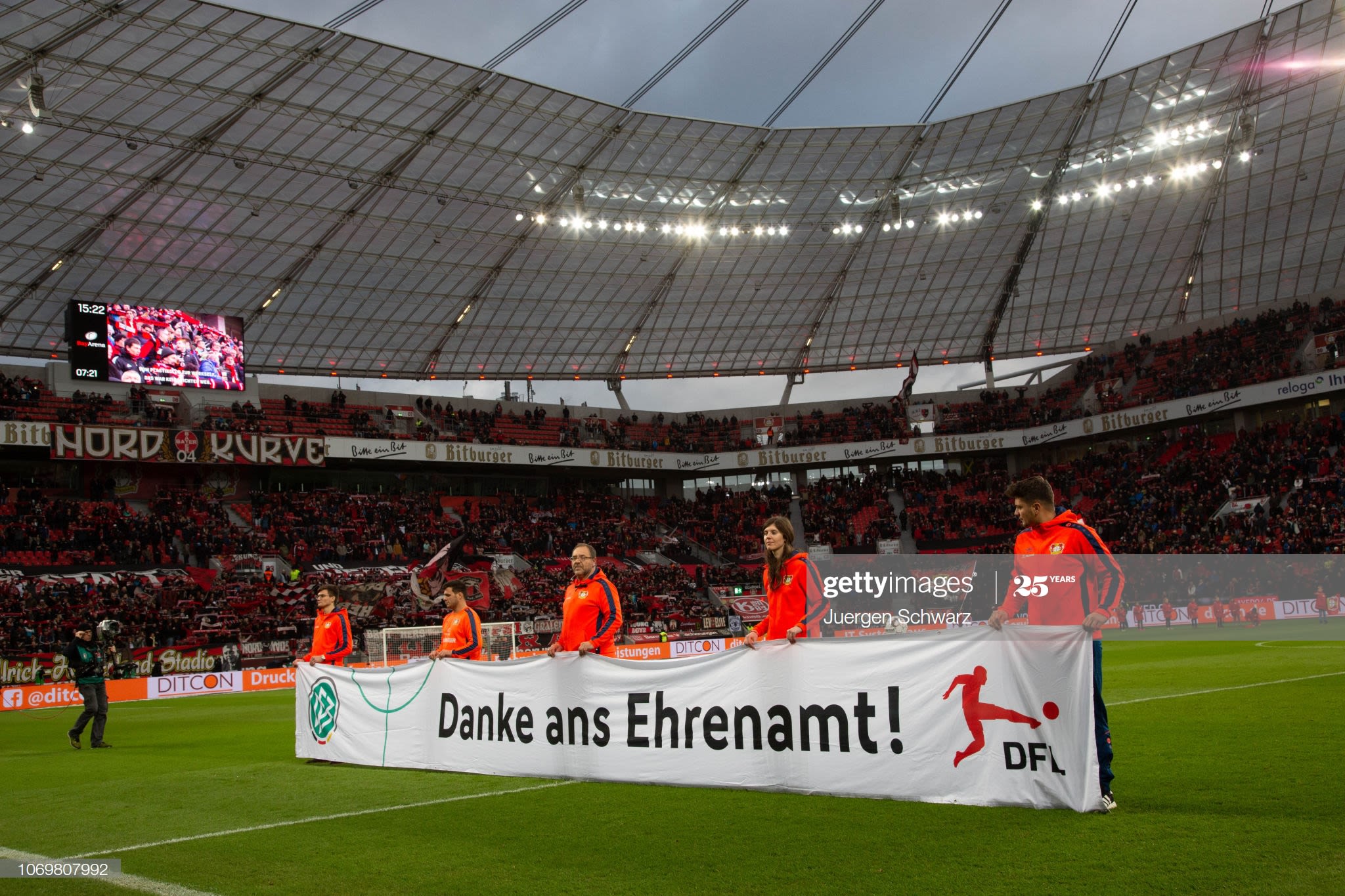

Title Picture - LEVERKUSEN, GERMANY - DECEMBER 08: Banners displayed on the pitch read "thank you for volunteering" during the Bundesliga match between Bayer 04 Leverkusen and FC Augsburg at BayArena on December 8, 2018 in Leverkusen, Germany (Juergen Schwarz/Bongarts/Getty Images)
Harry Crowe investigates the importance and significance of how sport and physical activity can benefit people and communities through a range of social and cultural outcomes and what more needs to be done to help further raise awareness. This article focuses on the hard work of committed volunteers behind-the-scenes on match days and the role Sport England plays in encouraging more volunteers across the country to get involved.
'Six million adults volunteered at least twice in the last year to support sport and physical activity', according to data from 'Sport England's Active Lives Survey'.
Two of those adults who volunteered and continue to do so are from County Durham, working behind-the-scenes at EBAC Northern League Division One side West Auckland Town - winners of the Sir Thomas Lipton Trophy in 1909 & 1911.
“I've been here 40 years,” says Clifford Alderson, match day secretary at West Auckland Town. “I started coming to the ground with my dad when I was about nine-years-old, and I joined the committee when I was 18 and I am still here.
“It's all been interesting. There is only a few of us involved and without us, it wouldn't be easy. What I do, I enjoy it, I enjoy doing it all.”
Nicknamed 'Cliffy', the 50-year-old has fond memories of the club's recent trips to Wembley for the FA Vase finals in 2012 and 2014, and admitted that's been one of his highpoints, “obviously, the two Wembley appearances, not for the results but the experience really,” he said, as they finished runners-up on both occasions.
Another dedicated volunteer at the club is Dave Bussey, who has been an assistant secretary at West Auckland for eight years.
“I moved away from the area for a while, but my dad used to take me when I was nine and ten-year-old,” Dave said. “My dad was a volunteer, he was on the committee and I used to go and help out after the game, picking the papers up and I used to sell cups of tea, bovrils, coffees and bags of crisps. That's all they used to sell.”
Dave stated his highlight was the club's League Cup triumph at the end of the 2018/19 campaign when they defeated Newcastle Benfield 4-3 on penalties at Seaham Red Star's Ferguson Motor Repairs Stadium. It was the first time in 56 years they had won the competition and only the third time in the club's history.


West Auckland Town scarf layered around Northern League Cup
West Auckland Town scarf layered around Northern League Cup
“The lads let me lift the League Cup, that's got to be me highlight,” says Dave. “It's the first time in my lifetime at West Auckland, they have won something. That will be a pub question in a few years' time - who lifted the Cup?”
His ambition is to see West win some silverware at the national stadium, adding: “I want to be alive and to be there to (watch) them lift a trophy at Wembley. That's me total dream and that'll be for my dad.”
“For most sports volunteers, a passion for the sport or activity they have been involved in can be a key motivator for volunteering,” says Jenny Betteridge, Strategic Lead for Volunteering at Sport England.
The data from the 'Active Lives Adult Survey', gathered by Sport England between November 2018 to 2019, shows the '13 per cent of adults aged 16 or over who volunteered at least twice in the last year' had undertaken a variety of roles with providing transport the most popular (39 per cent) and refereeing, umpiring and officiating the least common (22 per cent).
Further research shows that its more common for men to volunteer than women, 'a stark 16 per cent difference', and this is something that Jenny is already aware of and aims to use 'people like them' to help bring balance to the participation levels.
“We know that women are less likely than men to take part in sport and physical activity, and so perhaps less likely to be recruited to volunteer through taking part,” says Jenny. “Furthermore, some roles are more closely linked to playing sport, such as coaching and refereeing, which might explain why more men carry them out.
“If a conscious effort is made to encourage more women to take part in a wider range of roles, then it will also lead to more female role models within the sector being visible and a social norm being developed, which may help further encourage women to volunteer and take part in sport and physical activity.
“Understanding the potential barriers for women and what types of volunteer roles might appeal to their motivations is key to ensuring that the sport sector doesn’t continue to miss out on the wealth of skills, knowledge and experience women have to offer. It’s also important to address this inequality if we are to ensure that more women have the opportunity to benefit from some of the positive outcomes associated with volunteering; from social connections to improved wellbeing and opportunities to develop their skills.”
Jenny also believes that even a simple 'thank you' could be enough to persuade volunteers to stay on in their role as support from the public can make a huge difference.
“Personally, I would love volunteers to be the focus of more coverage, stories, thanks and recognition,” Jenny said. “There is a significant body of evidence across all types of volunteering showing that recognition is important to retaining and motivating volunteers (as well as attracting new ones). However, we also know that this does not need to be national awards or ‘rewards’ necessarily, and could just be a thank you from club members or other parents (Parkrun are excellent at this).
“Also, that alongside recognition, it is hugely important to share the impact of their help. To connect the task (setting up equipment, marshalling a route, being a club treasurer) back to the collective achievement (i.e. supporting 45 kids have a great cricket session and therefore helping their physical and mental wellbeing etc.).”
Without the generosity and thoughtfulness of volunteers, sport as we know it would not be the same.
Jenny concluded: “We know that the UK volunteering landscape is changing and how can we ensure that those who rely on volunteers within sport and activity are best equipped to offer and support modern, 21st century volunteering experiences. Then, in turn, how those volunteers have the right skills and behaviours to support all their participants to have a great activity experience. Helping create an active nation.”
 Built with Shorthand