
28 Years Later
An apocalypse that feels like home
It's been 28 years since the outbreak...
and Britain as we know it is long gone...
28 Years Later brings us back to the twisted world of the 'Rage Virus'. The third instalment in the post apocalyptic film series takes place almost three decades after the initial outbreak, and from the outset, the team behind the film had a vast amount of world building ahead of them.
Alex Garland's screenplay depicted a world where nature had reclaimed land from civilisation, and the locations in the film needed to convey that in order to live up to the story on the page. To bring the filmmakers' vision and dense mythology to life, while telling a tragic family story, the environments had to feel both believable and otherworldly at the same time.
Question is, where in the world do you turn in order to capture that kind of mythical atmosphere? As it turned out, the answers were found in the heart of Northumberland.
The North East of England has a rich history of film productions, and local landmarks such as the Sycamore Tree and Bamburgh Castle have been showcased in a variety of tentpole films.
While this has brought many major productions to the region, locations in the North East are generally used to portray a fictional place or different part of the world.
When the crew behind 28 Years Later embarked to tell the third chapter in the series, the location work was approached with a very different mindset.
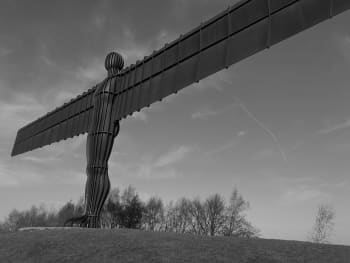
"We were all struck by the epicness of Northumberland"
Richard Styles
First Assistant Director and Co-Producer
In the first film, inhumane experiments on primates backfired, and the ‘Rage Virus’ was unleashed upon the British Isles. Infected members of mankind decayed into the most primal and violent versions of themselves. Even those who managed to avoid the disease lost their way, killing each other in the fog of war.
28 Years Later, man has regressed into an almost medieval way of life, which perfectly suited the landscapes in the North East. But other than providing a unique look to the film, Garland and Danny Boyle's decision to set the film in Northumberland filled important narrative purposes, which is where Lindisfarne entered the picture.
Thanks to an isolation from the mainland, a society on Lindisfarne has managed to survive the infection while establishing a functioning society offshore. Akin to a medieval village, the locals are relying their survival on fishery and dangerous hunting expeditions to the mainland.
The location work seeped into every fibre of the film. The choice of cameras, the staging of scenes and execution of set pieces was all informed by the landscapes of Northumberland and the desire to set the film in remote parts of the North East.
Action sequences were filmed with consumer-grade drones, and frantic shots of the infected were captured by rigs carrying arrays of iPhones. By using nimble cameras, light equipment and bringing along smaller crews, the Northumberland wilderness became accessible and opened up a world of creative opportunities.
"What could we find that looks like it's been left alone for 28 years?"
Camilla Stephenson
Supervising Location Manager
Seeking to find locations that captured the aesthetic of nature left abandoned for nearly three decades, the location crew and creative team had a monumental task ahead of them.
The crew travelled all over the U.K. to find places that would express what they were looking for. "We would literally spend hours in a minibus driving up and down what felt like the length and breadth of England, trying to find these locations," said Richard Styles.
Letting the location lead the way
Almost halfway through the film, the audience is introduced to a platoon of Swedish soldiers that get stranded on the British Isles while patrolling the shoreline. Their introductory scene originally saw them get washed ashore before making their way through the woods onto a motorway. But as the location department discovered Kielder reservoir, plans changed and the scene was reworked. "We just loved the overflow of the reservoir so much, that we really just made that up," said Stephenson.
A similar pivot happened while the crew were location scouting a petrol station. As the owner warned about the risk of flammable fumes, a creative spark was ignited. "He was the one who inspired the whole explosion," she said. This became the inspiration for one of the film's major set pieces. "He probably didn't even know it, but he inspired that," Stephenson continued.
In the opening of the film, a scene shows the day to day life of the inhabitants on Holy Island, which is something Stephenson is especially proud of.
"I think what we captured with the montage on Holy Island worked really well and what it's saying about the community. I think that captures what we wanted to say from the start," she said. "That's something you usually do in case you have time. But Danny was determined that it was done properly," Stephenson added.
 Built with Shorthand